Push/Pull/Legs Split: The Complete Guide
What it is, the 3-day and 6-day schedules, a full sample routine with sets and reps, who it suits — and who it doesn't.
Contents
Push/pull/legs (PPL) groups exercises by the direction of movement instead of by body part: pushing lifts (chest, shoulders, triceps) on one day, pulling lifts (back, biceps) on another, and legs on a third. Run it once through for a 3-day week, or twice through for 6 days.
It suits someone who already knows the main barbell and machine lifts and wants more weekly training volume than a full-body routine gives each muscle. It's overkill for a first-time lifter still learning technique — a full-body split repeats the same lifts more often and teaches them faster.
What "push," "pull" and "legs" actually mean
Every upper-body exercise either pushes weight away from you or pulls it toward you, and those two motions use almost entirely different muscles — which is the whole point of splitting them apart.
| Day | Trains | Typical lifts |
|---|---|---|
| Push | Chest, front & side shoulders, triceps | Bench press, overhead press, dips, tricep pushdowns |
| Pull | Back, rear shoulders, biceps | Deadlift, rows, pull-ups, curls |
| Legs | Quads, hamstrings, glutes, calves | Squat, Romanian deadlift, leg press, calf raises |
Because nothing on push day taxes the muscles pull day needs, and vice versa, you can train close to your limit on consecutive days without one session eating into the next one's recovery. That's the mechanical reason PPL lets you fit in more weekly volume than a full-body split, which has to spread every muscle across every session.
3-day vs. 6-day: which schedule
Both run the same three sessions — the only difference is how many times you go through them in a week.
- 3 days a week (e.g. Mon/Wed/Fri: Push, Pull, Legs) — each muscle gets trained once a week. Fits around a job or studies, and is the more forgiving place to start with PPL. Miss a day and you've missed one session, not half a body's worth of training.
- 6 days a week (e.g. Mon-Sat: Push, Pull, Legs, Push, Pull, Legs) — each muscle gets trained twice a week, roughly doubling weekly volume. That's more stimulus for building strength and size, but it only works if sleep, food and stress can actually support six sessions. Running 6 days on 3 days' worth of recovery is a way to get slower, not faster.
If you're not sure which to start with: start with 3. You can always add the second pass once the first is easy to recover from.
A full sample routine
Sets and reps below, no weights — nobody but you knows what you can lift, and a guessed number on your first set is worse than a blank one. Warm up on each session's first couple of lifts before working sets, and treat the last rep or two of every set as the ones that should feel hard.
Push
| Exercise | Sets × reps |
|---|---|
| Bench press (barbell) | 4 × 8 |
| Dumbbell overhead press | 3 × 10 |
| Incline dumbbell press | 3 × 10 |
| Lateral raise | 3 × 15 |
| Tricep pushdown (rope) | 3 × 12 |
| Overhead tricep extension (rope) | 3 × 12 |
Pull
| Exercise | Sets × reps |
|---|---|
| Deadlift | 3 × 5 |
| Pull-up | 4 × 8 |
| Seated cable row | 3 × 10 |
| Face pull | 3 × 15 |
| Barbell curl | 3 × 10 |
| Incline dumbbell curl | 3 × 12 |
Legs
| Exercise | Sets × reps |
|---|---|
| Squat | 4 × 8 |
| Romanian deadlift | 3 × 10 |
| Leg press | 3 × 12 |
| Leg curl (lying) | 3 × 12 |
| Calf raise (standing) | 4 × 15 |
| Hanging leg raise | 3 × 12 |
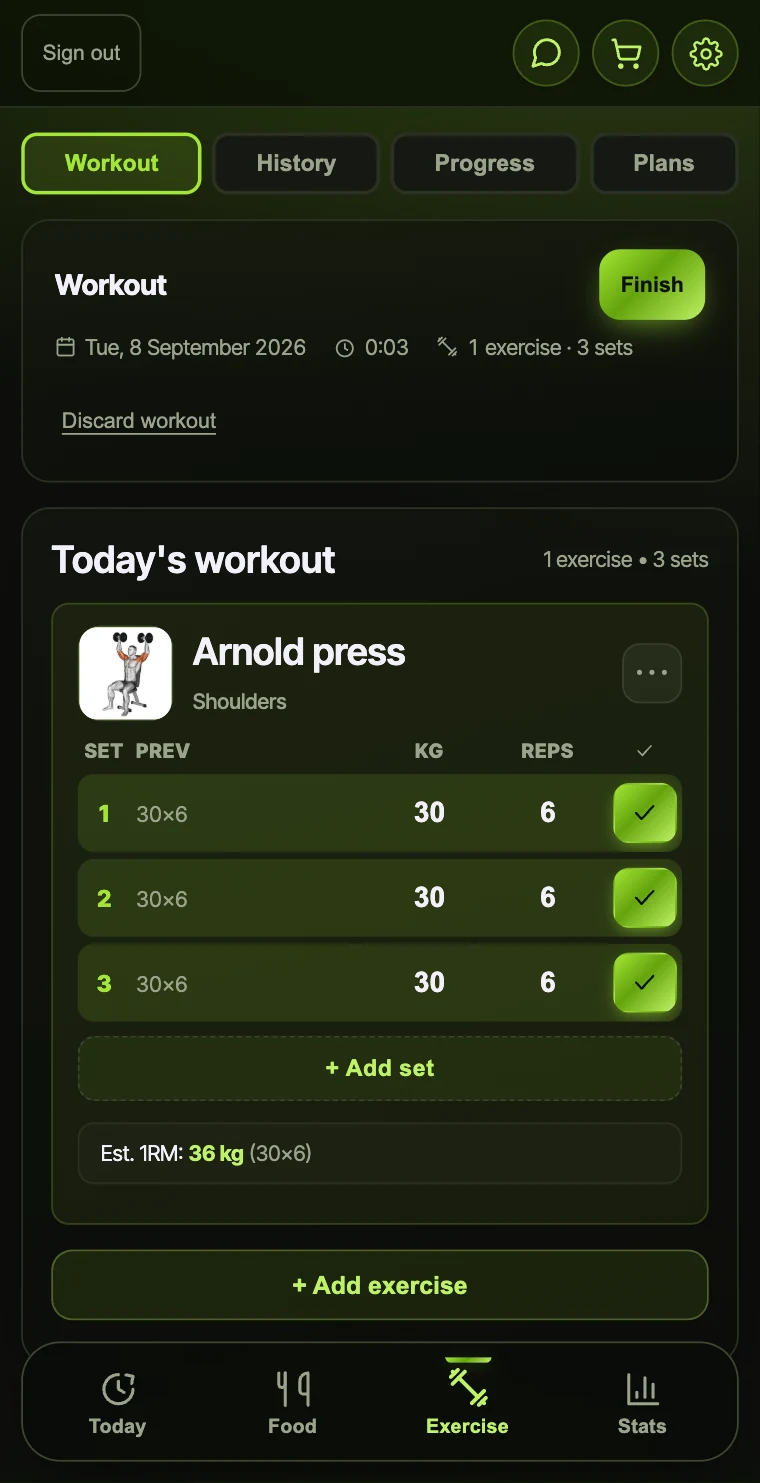
This exact routine is a one-tap starter programme in FitnessMaxxing — it installs all three sessions as ready-to-log plans.
Open the appProgression: how to actually get stronger on it
The routine only works if the numbers move. The rule that matters most: when you can complete every set at the top of a rep range with good form, add weight next session and drop back to the bottom of the range. A log that only records what you did, not what you're aiming to beat, makes this invisible — you need last session's numbers in front of you before you start the next one.
Progress won't be linear on every lift every week, and it doesn't need to be. What matters over a month is the trend, not any single session.
Who this split doesn't suit
- Complete beginners. A full-body split, training the same core lifts 3 times a week, builds technique faster because you get more practice reps on each movement, sooner.
- Anyone who can only commit to 2 days a week. PPL needs at least 3 sessions to complete one full pass; 2 days is better served by an upper/lower or full-body split.
- Anyone chasing a single strength lift above general size and strength. Powerlifting-specific programming trains the competition lifts far more often than PPL's once- or twice-a-week frequency allows.
Frequently asked questions
Is push/pull/legs good for beginners?
It works for beginners, but a full-body split usually teaches exercise technique faster because you repeat the same handful of lifts more often per week. PPL suits someone who already knows the main lifts and wants more weekly volume per muscle group than full-body allows.
Should I run PPL 3 days or 6 days a week?
3 days suits most people alongside a job or studies. 6 days roughly doubles weekly volume per muscle group and suits someone who can also recover — sleep, food and stress all have to hold up, or 6 days becomes a way to get slower, not faster.
What's the difference between push/pull/legs and upper/lower?
Upper/lower splits the body two ways and trains each muscle roughly twice a week on 4 days. Push/pull/legs splits it three ways, so each session is shorter and more focused, but training a muscle twice a week needs the 6-day version rather than the 3-day one.
How long until I see results on PPL?
Strength on the main lifts usually moves within 2-4 weeks as your nervous system adapts to the movements. Visible muscle change takes longer — 8-12 weeks of consistent training and enough food is a realistic first checkpoint.
Do I need to change exercises every session?
No. Repeating the same exercises for weeks is what lets you track progressive overload — more weight or more reps than last time. Swap something only if it's causing pain or you've plateaued on it for a long time, not out of boredom.
Log every set, watch estimated 1RM and PRs climb automatically, no spreadsheet required.
Open the app